

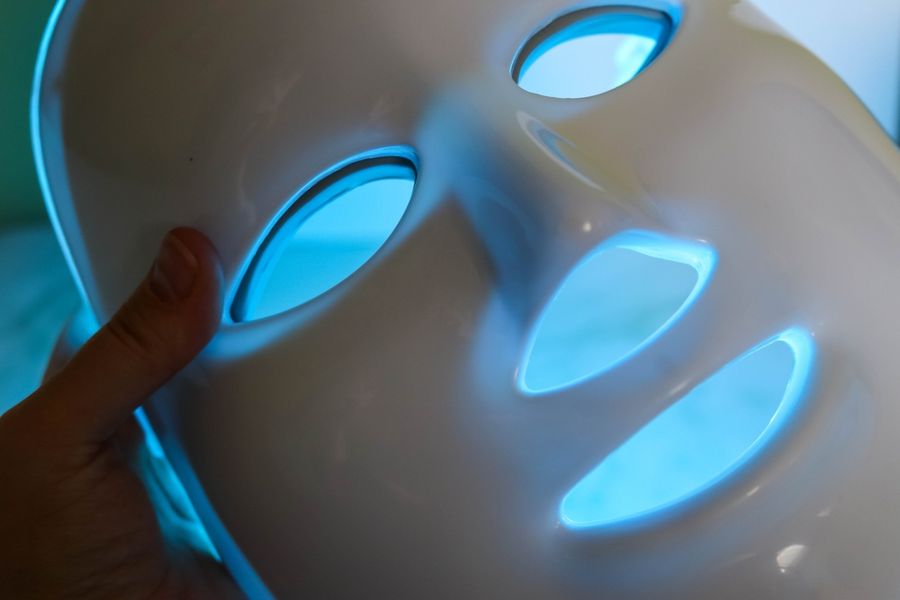
Walk into any pharmacy or scroll through social media and you're bound to spot one — a glowing, futuristic mask packed with tiny lights that fits over the whole face. LED face masks have moved from high-end spas into everyday homes, promising clearer skin, fewer fine lines, and a more even tone. With a growing number of at-home options now on store shelves, it's worth understanding what the science actually says before making the investment.
The Science Behind the Glow
The story of light therapy begins in the 1960s, when a Hungarian physician named Endre Mester shined a low-powered red laser on mice to study its effects on tumor growth. Instead, he found that the light appeared to speed up hair regrowth and wound healing — a surprise discovery that launched decades of further research (source). By the 1990s, NASA had taken notice and began exploring how light-emitting diodes could help astronauts recover from tissue damage while in space (source).
Today, scientists refer to this process as photobiomodulation, or PBM — a straightforward idea that specific wavelengths of light can gently encourage the body's natural cellular functions (source). Different wavelengths reach the skin at different depths, each targeting a unique set of concerns. This is the core principle that powers modern LED masks.
How Different Light Colors Work on Your Skin
Red and near-infrared light travel deeper into the skin, where they trigger a biological chain reaction inside the mitochondria — the energy-producing centers of cells. This reaction generates key molecules that support energy production and healthy blood flow, which in turn pushes the skin to build more collagen and repair itself more effectively (source). With regular use, these effects can translate into smoother texture, softer fine lines, and improved firmness.
Blue light works differently and stays closer to the skin's surface. When absorbed, it sets off the creation of free radicals that slowly break down and destroy acne-causing bacteria known as P. acnes (source). Dermatologists who use blue light in their practices have observed real reductions in active breakouts and skin redness among their patients (source). Many at-home masks now combine both red and blue light to cover a broader range of skin concerns.
What At-Home LED Masks Can — and Can't — Do
The biggest distinction between LED treatments in a clinic and those performed at home comes down to power output. Professional-grade equipment operates at higher intensity levels, producing faster and more noticeable changes in the skin. At-home devices use lower-level output to ensure they remain safe for unsupervised daily use, which naturally limits the speed and scale of results (source).
While the science behind LED therapy is real and clinically valid, the results at home will not match those achieved through more intensive treatments in a medical setting (source). That does not make at-home masks useless — it simply means steady, long-term use matters more than any single session. Most people need several weeks of consistent treatment before they notice a genuine difference.
What to Look For in an At-Home LED Mask
When choosing an at-home LED mask, FDA 510(k) clearance is one of the most useful markers to look for. This designation indicates the device has been reviewed and cleared by the FDA, offering at least a basic level of assurance about its safety before you put it on your face (source). Without this clearance, there is no regulatory check on the product's claims or construction.
Output intensity is equally important and often overlooked. Red light devices should ideally produce around 105 milliwatts per centimeter to be effective; for blue light, lower levels can still work, but anything below 10 milliwatts is unlikely to make any real difference (source). Shoppers should also be cautious about masks that advertise a rainbow of colors such as green, yellow, or purple. Experts point out that the only wavelengths with a solid body of scientific evidence behind them are red, near-infrared, and blue (source).
New Technology Is Closing the Gap
One stubborn problem with traditional at-home LED masks is their rigid shape. Because most sit a small distance away from the face rather than fitting snugly against it, a large share of the light bounces off before it can actually penetrate the skin. Research has found that over just two centimeters of distance, conventional masks can lose as much as 90% of their emitted light through reflection alone (source).
Researchers at KAIST, South Korea's leading science and technology institute, took aim at this problem by developing a flexible mask that uses a three-dimensional, origami-inspired structure to conform closely to the face's natural curves. The design incorporates thousands of tiny micro-LEDs within a soft, light-diffusing layer. In clinical trials involving 33 participants, this new mask produced a 340% improvement in deep skin elasticity compared to conventional rigid LED masks (source). Though not yet widely available, this research points toward a future where at-home devices may deliver results far closer to what professional settings can currently offer.
LED Masks: Worth It — With the Right Expectations
LED face masks are not miracle products, but they are not empty hype either. The science behind light therapy is well-established, and regular use of a well-designed at-home device can bring about genuine improvements — especially for concerns like mild acne, fine lines, and overall skin tone (source). The key is choosing the right device and committing to consistent use over time, rather than expecting overnight results.
That said, this type of therapy is not appropriate for everyone. People who take certain medications that increase sensitivity to light, or who have a history of skin cancer or inherited eye conditions, should steer clear entirely (source). For those who are good candidates, speaking with a dermatologist before starting is the safest first step — and the best way to identify which type of device is actually worth bringing home.